Calender


We welcome the seventy-seventh iteration of the Annual Exhibition of Shōsō-in Treasures, which will take place amidst the resplendent autumn colors in the ancient capital of Nara. These treasures comprise approximately 9,000 objects that were stored in the famous azekurazukuri (log house construction) storehouse known as the Shōsō-in. They convey to us the refined arts and culture of the Tenpyō period (mid-eighth century) that blossomed in Nara, then known as the Heijō capital, almost 1,300 years ago. They have been carefully guarded under the imperial seal (chokufū) that restricts access; this has helped them remain a well-preserved set even today.
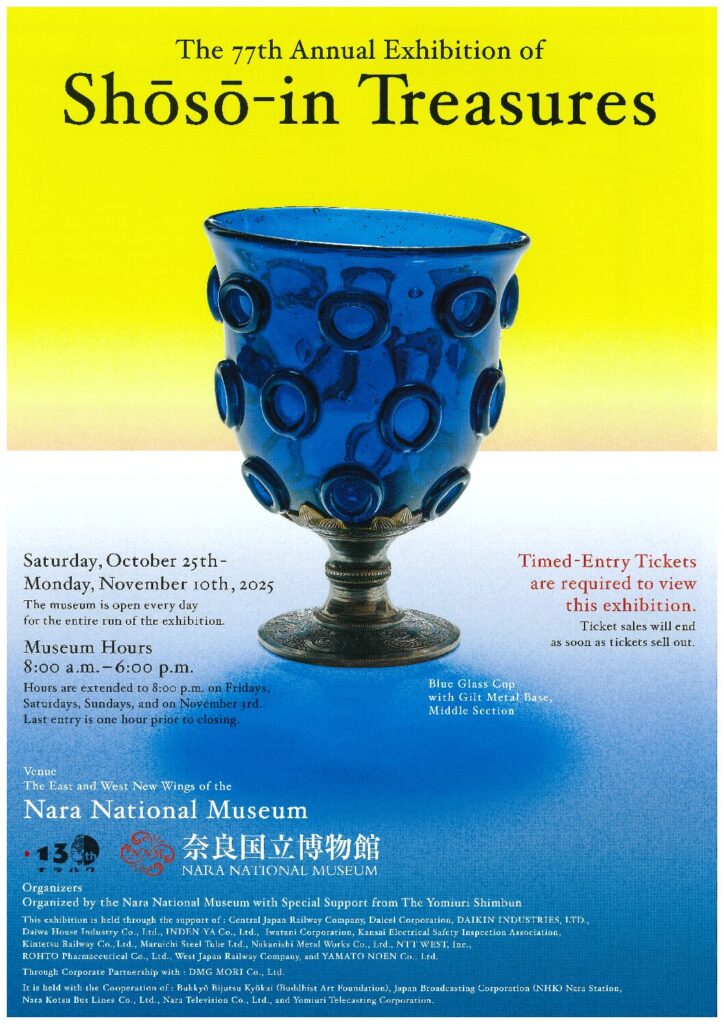
This year’s Shōsō-in Exhibition will feature a selection of treasures that will imbue the exhibition space with the splendor of the Tenpyō period. These objects were created with precious materials using highly sophisticated techniques, and evoke the glamorous, intellectual atmosphere of court life. Among them are exotic items such as the Red Sandalwood Sugoroku Board with Marquetry, used by Emperor Shōmu (701-756; r. 724-749) himself; the exquisite Blue Glass Cup with Gilt Metal Base; and the famous Aloeswood Incense “Ōjukukō” known as “Ranjatai.” These treasures provide a glimpse of the cosmopolitan atmosphere that was brought to Japan’s ancient capital via the Silk Road.
This year’s Exhibition of Shōsō-in Treasures will feature spectacular displays, including the results of the latest treasure investigations conducted by the Office of the Shōsō-in Treasure House, Imperial Household Agency.
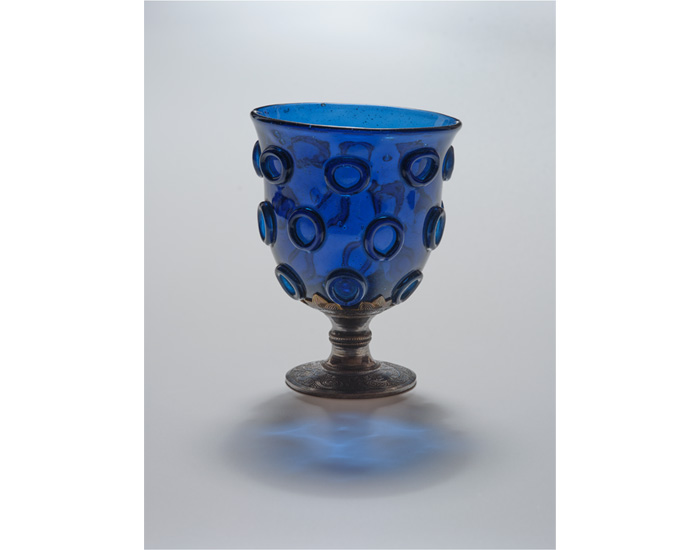
Middle Section 70
What is the Annual Exhibition of Shōsō-in Treasures?
Each year in the fall, the Imperial seal behind which the Shōsō-in Treasures are stored in the Repository at the Shōsō-in is opened for a short window of time for inspection. During this period, a selection of treasures is put on display to make the treasures accessible to the general public at The Annual Exhibition of Shōsō-in Treasures. The group of treasures brought out each year are selected to give a sense of the collection as a whole and to feature works that have drawn attention through recent research findings. The first exhibition was held in 1946 at what was then the Nara Imperial Household Museum. With the exception of three subsequent exhibitions in Tokyo (held in 1949, 1959, and 1981), the show has opened in Nara every year since.
What are the Shōsō-in Treasures?
While the treasures preserved through the centuries in the Shōsō-in Repository are believed to have entered the storehouse through various circumstances, the majority of them can be divided into the following three groups: 1. Those presented as offerings by Empress Kōmyō (701–760) to the Great Buddha of Tōdaiji on the twenty-first day of the sixth month in Tenpyō Shōhō 8 (756) after the forty-nine days of mourning following the passing of Emperor Shōmu (701–756; r. 724–749); 2. Various objects and implements used during ceremonies at Tōdaiji; and 3. Materials connected to the administration of Tōdaiji and its Scriptorium from the Tōdaiji Construction Bureau (Zō Tōdaiji Shi). There are also various ritual implements that were used in ceremonies at the palace, weaponry, and instruments. The breadth and variety of the treasures suggests several threads of history and provenance interweaving the collection’s objects.
Dates
Saturday, October 25th to Monday, November 10th, 2025
The museum is open every day for the entire run of the exhibition.
Venue
The East and West New Wings of the Nara National Museum in Nara, Japan
Hours
8:00 A.M. to 6:00 P.M., and until 8:00 P.M. on Fridays, Saturdays, Sundays, and Holidays
Last entry is sixty minutes before closing.
Admission
| General Admission | 2,000 JPY (Late Entry: 1,500 JPY) |
| University and High School Students | 1,500 JPY (Late Entry: 1,000 JPY) |
| Junior High and Elementary School Students | 500 JPY (Late Entry: Free) |
- Free of charge entry to disabled certificate holders and an accompanying caretaker (upon presenting the certificate); preschoolers; late entry rate (junior high and elementary school students); Nara National Museum Membership card holders (for first and second entry); Sponsorship Members (Nara National Museum, Tokyo National Museum [except Silver Members], Kyushu National Museum); Seifukai Members (Kyoto National Museum); and Special Supporters.
- Those benefitting from free admission do not need to purchase timed-entry tickets but are required to present their certificate or membership card upon arrival. (Except for junior high and elementary school students and younger)
- Please note that you cannot change, cancel, or reissue your timed-entry tickets, and there are no refunds.
- The Late Entry discount is available with timed-entry tickets only and applies from Monday through Thursday after 4:00 P.M. and after 5:00 P.M. on Fridays, Saturdays, Sundays, and Holidays.
- Excluding those benefitting from free admission, all tickets are timed-entry and must be purchased prior to one’s arrival at the museum.
- Ticket sales will end as soon as the tickets made available for each timed-entry window have been sold out.
- If there are remaining tickets for timed-entry window, Same Day Timed-Entry Tickets are sold at Nara National Museum Special Ticket Counter.To avoid long lines, please purchase your ticket in advance.Timed-entry tickets can be purchased the same day online as one’s visit up to the start of each timed-entry window.
How to Purchase Timed-Entry Tickets
Tickets go on sale Friday, September 5th at 10:00 A.M.
Tickets are available for purchase through the following vendors and methods:
- LAWSON TICKET Use the L-Code 59600 at Lawson or Ministop stores or through its online ticketing website. Lawson Ticket Japanese Site: https://l-tike.com/77shosoin-ten/
- CN Play Guide Use the code 265-051 for Monday to Thursday 8am to noon; 265-052 for Monday to Thursday after 12pm; 265-053 for Friday, Saturday, Sunday, and Public Holiday 8am to noon; and 265-054 for Friday, Saturday, Sunday, and Public Holiday after 12pm and dial 0570-08-9920 (automatic response).
- E-Ticket (English available) https://www.e-tix.jp/shosoin-ten/en Exhibition Online Ticket (English version) https://www.e-tix.jp/shosoin-ten/en/ ONLINE TICKET USAGE GUIDE
Use the L-Code 59600 at Lawson or Ministop stores or through its online ticketing website. - ART EXHIBITION JAPAN
This app is only available in Japanese. It can be used on smartphones running iOS 13/Android 6.0 and over.
Museum Entry and Viewing the Exhibition
- You will not be permitted to enter the museum on a day or window of time other than that designated on your ticket.
- Depending on the circumstances in the galleries, you may be admitted slightly before the start of your ticket’s timed-entry window or a little while after it has begun.
- Because the galleries are typically at their most crowded at the start of each timed-entry window, we recommend that you plan on arriving at the museum shortly after the start of the time slot designated on your ticket.
- There is no rotation of works throughout the length of the exhibition.
- You may use your timed-entry Shōsō-in Exhibition ticket for admission to the Nara Buddhist Sculpture Hall and the Chinese Ritual Bronzes Gallery.
- There is no parking lot available at the museum. Please refrain from visiting the museum by car.
- The period from noon to 3pm is expected to be extremely crowded. Please make use of early mornings and late afternoons.
Same Day Ticket Admission
| General Admission | 2,200 JPY (Late Entry: 1,700 JPY) |
| University and High School Students | 1,700 JPY (Late Entry: 1,200 JPY) |
| Junior High and Elementary School Students | 700 JPY (Late Entry: Free) |
Location: Nara National Museum Special Ticket Counter
About This Year’s Treasures
Of the sixty-seven treasures included in this year’s exhibition, six are displayed for the first time.
There are seventeen treasures from the North Section, nineteen from the Middle Section, twenty-eight from the South Section, and three from the Shōgozō.
List of works
Organizer:
Nara National Museum
With Special Support from:
The Yomiuri Shimbun
Sponsors
The exhibition has been made possible with the support of: Iwatani Corporation; INDEN-YA Co., Ltd.; NIPPON TELEGRAPH AND TELEPHONE WEST CORPORATION; Kansai Electrical Safety Inspection Association; Kintetsu Railway Co., Ltd.; Central Japan Railway Company; West Japan Railway Company; DAIKIN INDUSTRIES, LTD.; Daicel Corporation; Daiwa House Industry Co., Ltd.; Nakanishi Metal Works Co., Ltd.; Maruichi Steel Tube Ltd.; YAMATO NOEN CO., LTD.; Rohto Pharmaceutical Co., Ltd; with
Through Corporate Partnership with:
DMG MORI Co., Ltd.
Cooperation
Japan Broadcasting Corporation (NHK) Nara Station; Nara Kōtsū Bus Lines Co., Ltd.; Nara Television Co., Ltd.; Bukkyō Bijutsu Kyōkai (Buddhist Art Foundation); the Yomiuri Telecasting Corporation
Flyer