

 Calender


Feature Exhibition
Feature Exhibition
On-Matsuri and the Sacred Art of Kasuga
The Kasuga Shrine Maidens
The Kasuga Wakamiya On-Matsuri is an annual festival during which offerings representing various performing arts traditions are presented to the Wakamiya deity at the o-tabisho, a sacred venue constructed to serve as the deity’s temporary sanctuary. For twenty-four hours, the deity is feted with music and dance. On-Matsuri is especially renowned for the furyūgyōretsu, the procession of the ritual’s participants transporting the deity, along with the varieties of sacred dance and music that it encompasses like dengaku, bugaku, and sarugaku. The Heian-period origins of On-Matsuri are evidenced by records tracing back to 1136 (Hōen 2). Its traditions have been protected and carried on through the generations, and this year marks its 888th observance.
Each year, the Nara National Museum hosts a Feature Exhibition introducing the On-Matsuri festival, its history, rituals, and its associated arts of Kasuga faith. This year, we focus on the shrine maidens (mikanko) who have made offerings of music and dance from the earliest moments of the On-Matsuri festival. Their performances have developed into their present form incorporating cultural influences from various periods. The mikanko are also tasked with conveying the prayers of the devotees from all ranks of society who assemble to worship the Wakamiya deity at the main worship hall of Kasuga Wakamiya Shrine. We are eager to present glimpses into the beautiful and sacred world of On-Matsuri, which includes the entire Yamato region. This year, we highlight the women who have long served as a link between the Wakamiya deity and the communities connected by their faith.
Finally, we extend our warm thanks to all those who have made this exhibition possible.
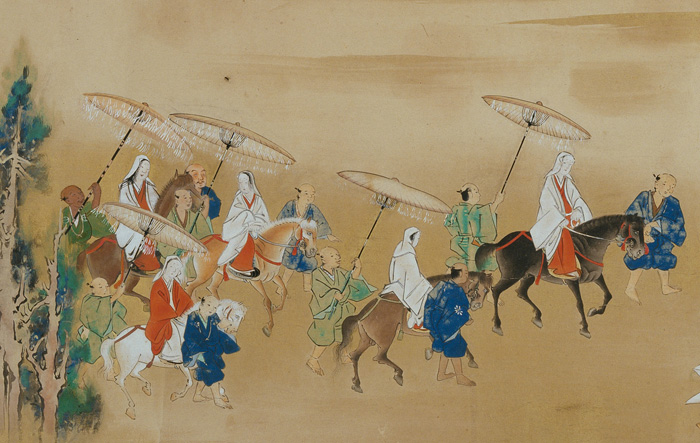
(Kasuga Taisha shrine, Nara)
Exhibition Dates
Saturday, December 9th, 2023 to Sunday, January 14th, 2024
Please note that the museum is closed on the following days: With the exception of January 8th, the museum is closed on Mondays; the holidays at the end and beginning of the year (Thursday, December 28th to Monday, January 1st); Tuesday, January 9th
Venue
The West Wing of the Nara National Museum
Hours
The museum is open every day from 9:30 a.m. to 5:00 p.m.
Last admission is thirty minutes before closing.
However, on the day of the Kasuga Wakamiya On-Matsuri O-Watari (December 17th), the museum is open until 7:00 p.m.
Admission
| General Admission | 700 JPY |
| University Students | 350 JPY |
- Admission is free for all guests on the day of the Kasuga Wakamiya On-Matsuri O-Watari (December 17th).
- For those bringing along with them a guest who is a high school student or under and/or under the age of 18, please enjoy a 100 JPY discount on admission. Likewise, those bringing along a college student can enjoy a 50 JPY discount.
- Admission to this exhibition also grants entry to the Feature Exhibition showcasing newly repaired cultural properties (Tuesday, December 19th to Sunday, January 14th); the exhibition of Buddhist masterworks from the museum’s collection; the Nara Buddhist Sculpture Hall; and the Chinese Ancient Ritual Bronzes Gallery.
- From January 2nd to 5th, free passes to the exhibition are distributed at the inner sanctum of Kasuga Taisha.
Organizers
Nara National Museum, Kasuga Taisha, Bukkyo Bijutsu Kyōkai (Buddhist Art Foundation)
Featured Items:
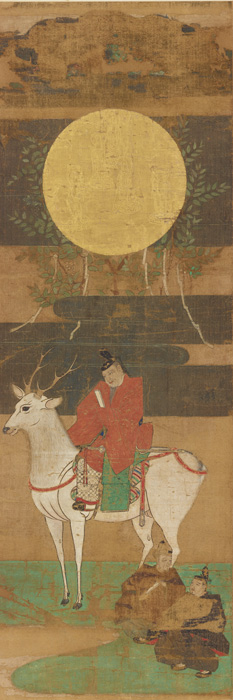
By Nijō Ei’in
[Kasuga Taisha Shrine, Nara]
Nanbokuchō period, 1383 (Eitoku 3)
Takemikazuchi no Mikoto, who is enshrined in the first sanctuary at Kasuga Taisha Shrine, rides a divine white deer from Kashima Shrine Hitachi Province (present-day Ibaraki Prefecture) to the sacred geography of Kasuga. Accompanying the deity in the foreground are two of the earliest priests, venerated as patriarchs, of what is now Kasuga Taisha Shrine: Nakatomi no Tokifū and Hidetsura.
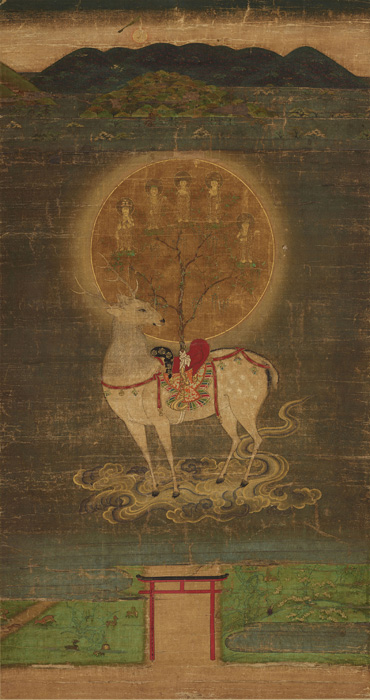
[Nara National Museum]
Kamakura period, 13th–14th century
Painted in resplendent detail, the divine deer believed to be the messenger of the Kasuga deities floats in against the backdrop of the mountains Mikasayama and Kasugayama. At the ends of the branches of the sacred wood that is mounted on the deer’s saddle are the Buddhas and bodhisattvas believed to be the original forms of the local kami enshrined in the five sanctuaries of Kasuga Taisha Shrine.
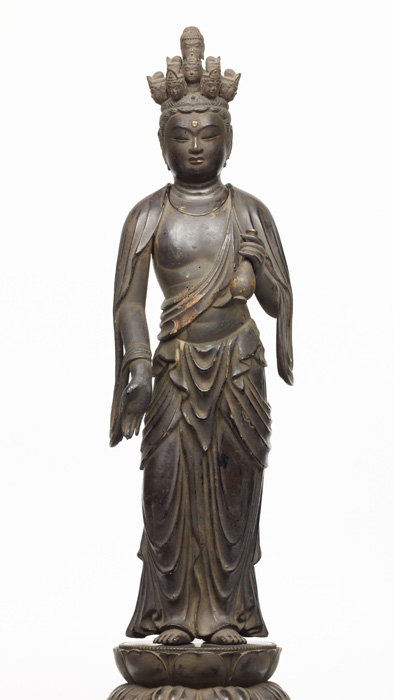
By Zen’en
[Nara National Museum]
Kamakura period, 1221 (Jōkyū 3)
The youthful features of this statue invites connection. It is thought to have been produced as the Buddhist form of the kami enshrined in the fourth sanctuary at Kasuga Taisha Shrine on the basis of inscriptions that were left on the inner surfaces of the statue and a deposited sutra scroll. In spite of the present appearance of this statue, it was once resplendent with polychroming in vivid colors and gold leaf.
[Kasuga Taisha Shrine, Nara]
Edo period, 17th century
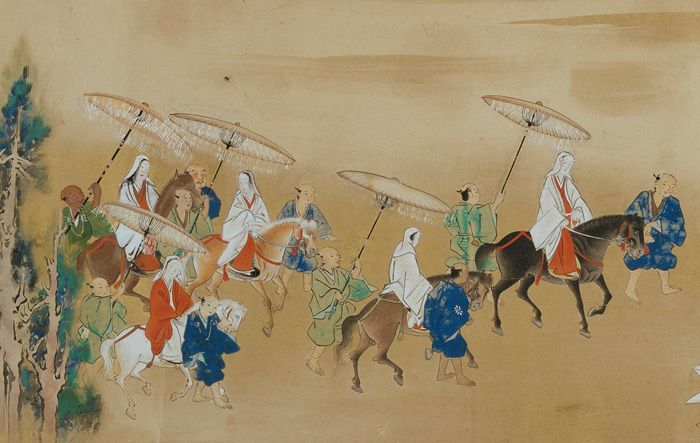
This work is particularly important for offering a sense of the On-Matsuri festival as it was held in the Edo period (1603–1867). It proceeds in the order of the festival’s program. The first scroll shows events that take place the evening before the festival begins, like the Ōshukushosai and the Yoimiyamōde. The second scroll has the proper start of the festival and includes the Owatarishiki procession. The last scroll starts with the Otabishosai and continues on to the Goennonō.
[Kasuga Taisha Shrine, Nara]
Contemporary, 1993
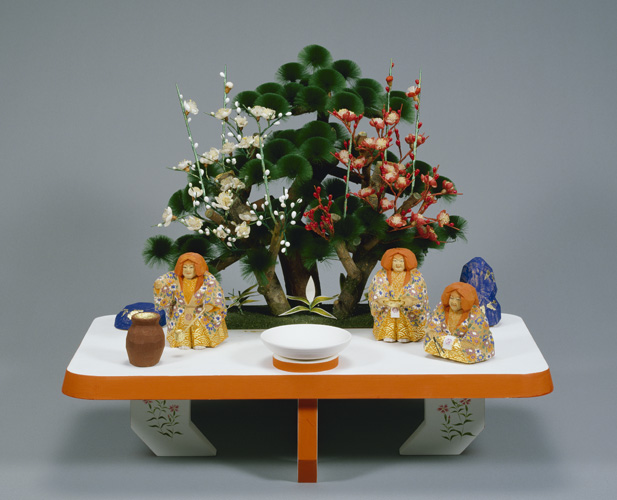
This is a decorative furnishing used during one of the ceremonies that takes place before the start of the On-Matsuri festival, the shōzokutabari. On top of a Japanese cypress wooden stand, doll-like figurines stand in front of pines, bamboo, and plum blossoms made from paper. In front of these are the small wooden sculptures representative of one of Nara’s traditional crafts known both as ittōbori and nara ningyō. In fact, trays for sake cups like this one were important to the formation of the ittōbori tradition.
[Kasuga Taisha Shrine, Nara]
Contemporary, 20th century
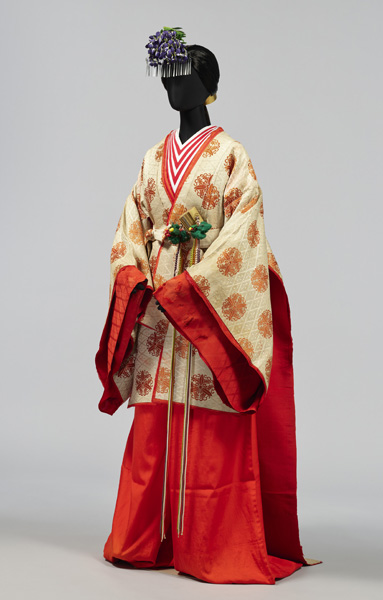
This is a costume that is worn by the shrine maidens who perform dances and musical performances as offerings to the gods at the On-Matsuri festival. It is comprised of trouser-like long hakama and a collar with eight layers of red and white cloth in alternating layers. Over this is an overcoat-like maiginu for dance. The costume is worn in a dance performed by two people. The maiginu has a double-woven fabric with a motif of round wisterias over a three-layered white tasuki ground. The head ornament made of paper wisteria flowers and leaves adds further wisteria to the attire.