

 Calender


Special Exhibition
Special Exhibition Celebrating the 1,250th Anniversary of Priest Kūkai’s Birth
KŪKAI
The Worlds of Mandalas and the Transcultural Origins of Esoteric Buddhism
My vow is extinguished when emptiness, sentient beings, and extinguishment itself can be extinguished.
“I will strive to rescue all sentient beings of this universe from the cycle of death and rebirth until everything, including Buddhism itself, ceases to exist.”
Shōryōshū, Scroll Eight
Aspiring to offer a path to salvation to one and all, the great monk Kūkai (774–835), a figure of unparalleled importance in the religious world of the early Heian period (794–1185), set out to transmit to Japan the esoteric Buddhist tradition referred to in Japanese as mikkyō. The teachings, practices, and iconographies encompassed by mikkyō first emerged in India, where Buddhism began, and it traveled across the maritime and continental trade routes known as the Silk Road to reach China. Striving to bring the teachings of the Buddha to as many as he could reach, Kūkai traveled to Tang-dynasty China. There, after a fateful encounter with the high priest Huiguo (746–805), he received esoteric initiations as Huiguo’s disciple. Upon returning to Japan, to protect the country and rescue sentient beings, he fervently spread mikkyō far and wide.
A tradition of secret and impenetrable teachings, mikkyō cannot be fully grasped in words alone. At this exhibition, which celebrates the 1,250th anniversary of Kūkai’s birth, we explore what exactly these mysterious teachings that Kūkai transmitted were, how he understood the world, what he saw, and how he interpreted all that he encountered. We create the sacred realms of mikkyō mandalas and the pantheon of deities they encompass within the exhibition space, granting access to an experience of what Kūkai wanted us to see with our own eyes, and we showcase the Takao Mandara for the first time since its conservation. The Takao Mandara is the earliest extant example of a paired Womb World and Diamond World mandala set and the only one that was produced with Kūkai’s direct involvement. By bringing together an overwhelming display of sacred treasures of mikkyō arts from China, Indonesia, and Japan, this exhibition enfolding completely unprecedented perspectives not only conveys the history of the transcultural transmissions of the mikkyō tradition, but also presents an experience of mikkyō cosmology as Kūkai intended to share it.
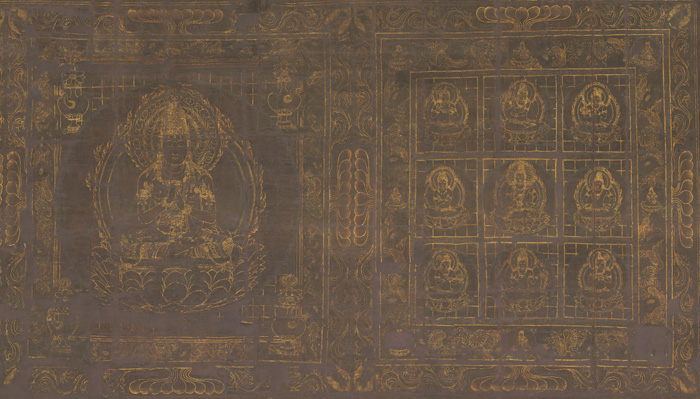
Mandalas of the Two Worlds (Takao Mandara): Diamond World, Detail
(Jingoji Temple, Kyoto)
Dates
Saturday, April 13th to Sunday, June 9th, 2024
The museum is closed on Mondays* and on Tuesday, May 7th.
*The museum is open on Mondays that are also national holidays. (It will be open on April 29th and May 6th.)
Venue
The East and West New Wings of the Nara National Museum
Hours
9:30 A.M. to 5:00 P.M.
Last entry is thirty minutes before closing.
Please note that exhibition hours differ from those of the permanent collection galleries.
Admission
| Same-Day Tickets | Group Tickets* | |
| General Admission | 2,000 yen | 1,800 yen |
| High School and University Students | 1,500 yen | 1,300 yen |
- Admission is free for students who are middle school age and below.
- Advanced tickets can be purchased from Tuesday, February 13th to Friday, April 12th.
- Tickets for the Special Exhibition also grant entry to the Nara Buddhist Sculpture Hall and the Ritual Bronzes Gallery.
- Tickets can be purchased online through e-tix or at the Nara National Museum ticket booth.
Organizers
The Nara National Museum, Japan Broadcasting Corporation (NHK) Nara Station, NHK Enterprises, Osaka Branch Office, and the Yomiuri Shimbun
Academic Advisor
Koyasan University
Sponsors
Nissha Co., Ltd.; Kinden Corporation; Tsuno Co. Ltd.; Panasonic Holdings Corporation; Non-Destructive Inspection Co., Ltd.
With the Cooperation of:
The Museum Nasional Indonesia, Jakarta, The Cultural Bureau of Shaanxi Province, The Shaanxi Provincial Cultural Heritage Administration, The Xi’an Beilin Museum, Shuchiin University, NipponKodo, and the Association of Buddhist Art (Bukkyō Bijutsu Kyōkai)
Featured Items:
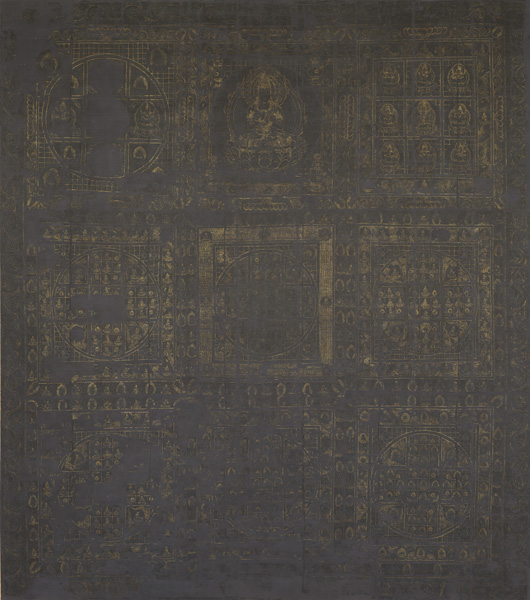
[Jingoji Temple, Kyoto]
Heian period, 9th century
This is the earliest extant pair of the Diamond World and Womb World mandalas, together forming the Mandalas of the Two Worlds known as the Takao Mandara. The pair has been passed down through the generations at Jingoji Temple at Mount Takao and is the only extant such set that was produced during the lifetime of Kūkai (774–835). Conservation of these paintings was completed in 2022, restoring the former brilliance of the gold and silver paint expressing their realms of deities.
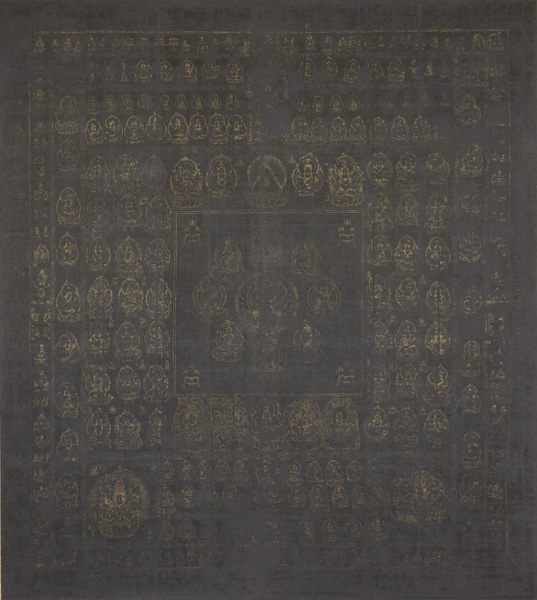
[Jingoji Temple, Kyoto]
Heian period, 9th century
This is the earliest extant pair of the Diamond World and Womb World mandalas, together forming the Mandalas of the Two Worlds known as the Takao Mandara. The pair has been passed down through the generations at Jingoji Temple at Mount Takao and is the only extant such set that was produced during the lifetime of Kūkai (774–835). Conservation of these paintings was completed in 2022, restoring the former brilliance of the gold and silver paint expressing their realms of deities.
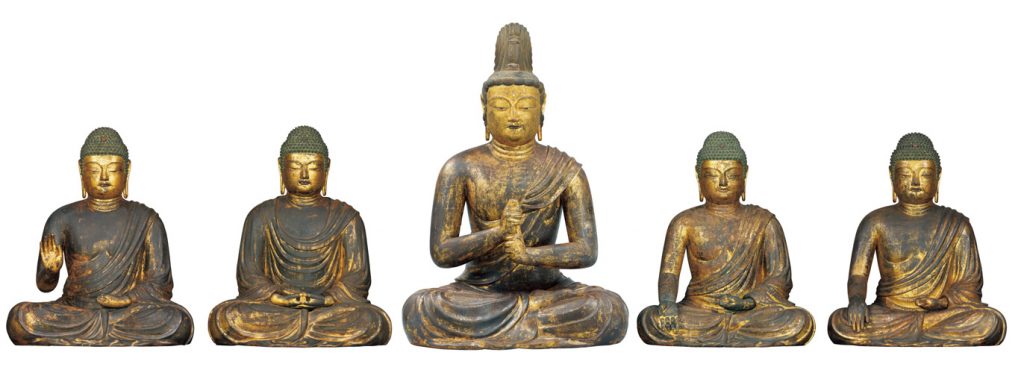
[Anshōji Temple, Kyoto]
Heian period, 9th century
It is said that the temple Anshōji was established in Kashō 1 (848) by Kūkai’s (774–835) lineage descendent in the second-generation, the monk Eun (798–869). These statues are thought to have been completed soon after, making them the earliest extant complete set of this iconography expressed in sculpture. Their robust forms in a nearly human scale create a naturalistic impression.
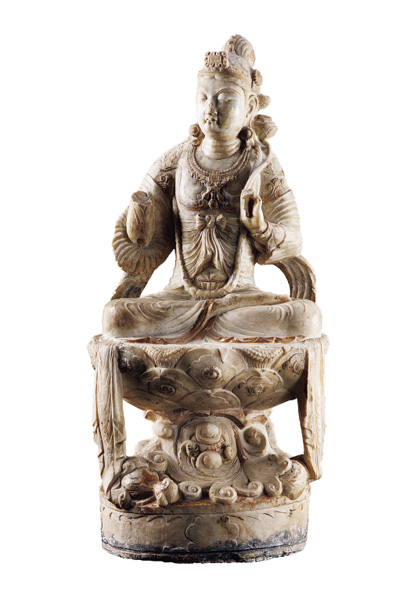
Excavated from the Anguosi Temple Site in Xi’an
[Xi’an Beilin Museum]
China, Tang dynasty, 8th century
This statue was discovered at the site of Anguosi Temple, which had been a grand institution in the Tang-dynasty capital of Chang’an. This and other sculptural traces discovered in excavating the Anguosi site eloquently evoke the flourishing of esoteric Buddhism at the Tang capital. It is understood to have been an icon of Wenshu (Skt. Mañjuśrī), but its attire and the attributes it holds are similar to those of the bodhisattva Kongōharamitsu (Skt. Vajrapāramitā) of the Womb World iconography.
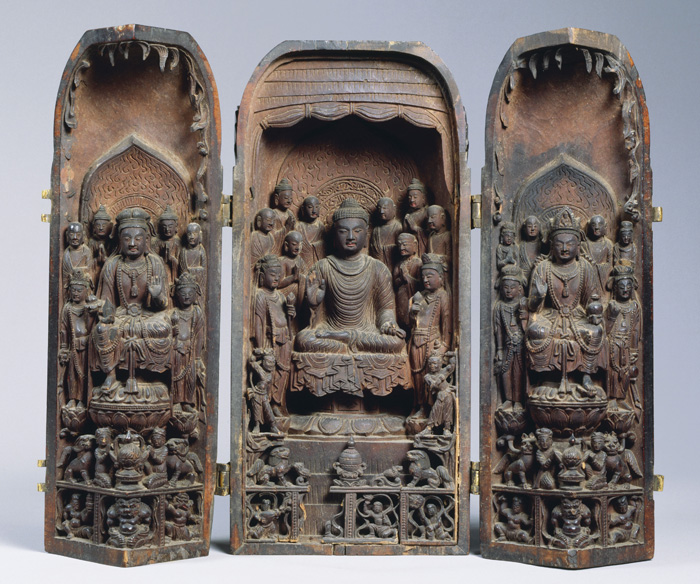
[Kongōbuji Temple, Wakayama]
China, Tang dynasty, 7th–8th century
This is known as the pillow-shaped honzon, or principal icon. It opens to reveal three surfaces of assembled Buddhist deities, and when its doors close, it takes the form of a Buddhist stupa. The various deities are in the style developed in Tang-dynasty China to evoke works from India, suggesting its date and region of production. It is possible, however, that this was copied elsewhere from an earlier model. The portable shrine is believed to have been presented to Kūkai (774–835) by his teacher, the master Huiguo (746–805).
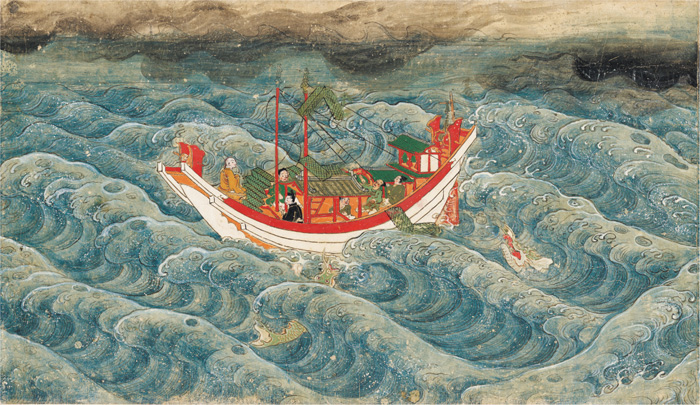
[Kyōōgokokuji (Tōji) Temple, Kyoto]
Nanbokuchō period, Kō’ō 1 (1389)
This illustrated biography in twelve scrolls was completed for the 600th anniversary of Kūkai’s birth. It depicts several important episodes from his life found as well in earlier illustrated biographies, but additional scenes related to Tōji Temple are unique to this work. The third scroll offers a vivid rendition of Kūkai’s arduous journey to China and his first meeting with Huiguo, the master who would become his teacher.

[Zentsūji Temple, Kagawa]
China, Tang dynasty, 9th century
This is the finial from a priest’s staff that Kūkai brought back from China. Such staffs were originally used during mountain pilgrimages, but they came to be incorporated into Buddhist ceremonies to add clanging sounds regarded as exotic to Japanese ritual. Note the masterful refinements of cast bronze technique reflected in the ornate expression of their Amida triads and flanking heavenly beings. The detailed depiction of the central Amida figure is not only poignant for its beauty, but also for its resemblance to contemporaneous bronze Buddhist sculpture from its precise style period.

[Kyōōgokokuji (Tōji) Temple, Kyoto]
China, Tang dynasty, 9th century
These are ritual implements used in the grandest of the major ceremonies in the Shingon tradition, the Goshichinichi Mishiho. The five-pronged vajra pestle and the five-pronged vajra bell, both of which please the Buddhist deities who can grind evil into dust, are arranged on an adamantine tray for the performance of the ceremony. Kūkai (774–835) brought these profoundly important implements back from Tang-dynasty China. They are listed in the Kōbōdaishi Shōrai Mokuroku, the record of the objects, texts, and images he transmitted to Japan.
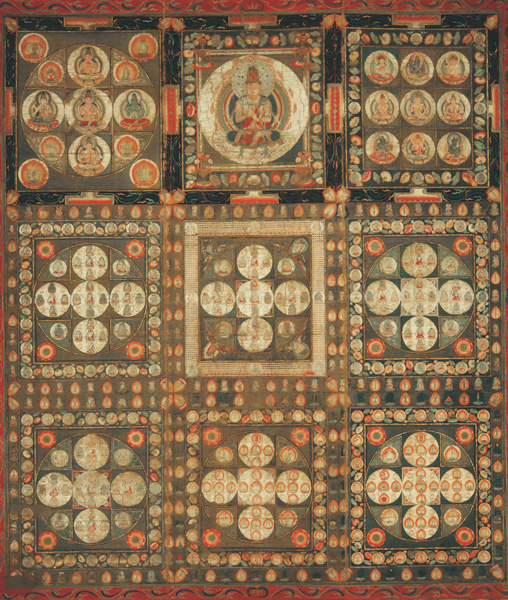
[Kyōōgokokuji (Tōji) Temple, Kyoto]
Heian period, 9th century
This is the earliest extant set of polychrome mandalas of the Womb World and the Diamond World brought together as a pair. They come from the Shingon’in within the Imperial Palace where they were used in the Goshichinichi Mishiho ritual and were, for many years, enshrined at the Saiin of Tōji Temple. Their depictions in vivid colors of deities expressed in a refined mode evoking the Heian-period imaginaire of distant lands draw one into their vibrant realms.
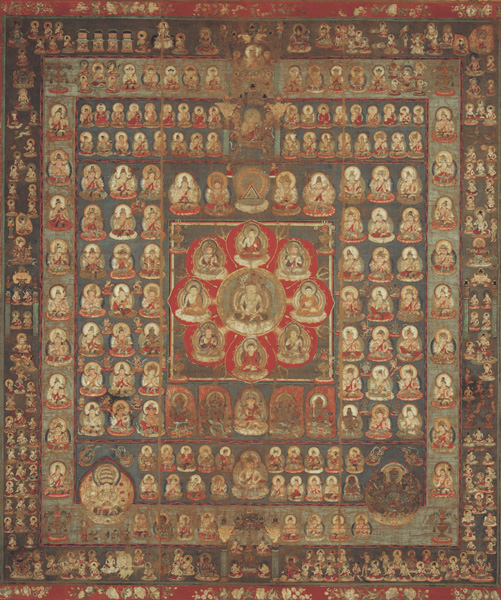
[Kyōōgokokuji (Tōji) Temple, Kyoto]
Heian period, 9th century
This is the earliest extant set of polychrome mandalas of the Womb World and the Diamond World brought together as a pair. They come from the Shingon’in within the Imperial Palace where they were used in the Goshichinichi Mishiho ritual and were, for many years, enshrined at the Saiin of Tōji Temple. Their depictions in vivid colors of deities expressed in a refined mode evoking the Heian-period imaginaire of distant lands draw one into their vibrant realms.
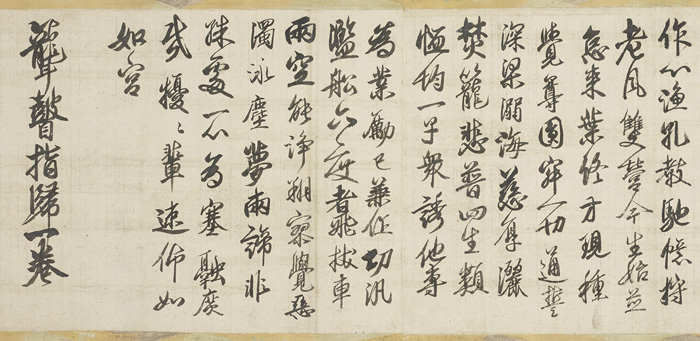
[Kongōbuji Temple, Wakayama]
Heian period, 8th–9th century
This is a work that Kūkai (774–835) wrote when he was twenty-four, prior to his ordaining as a Buddhist monk. It represents the traditions of Confucianism, Daosim, and Buddhism through fictional characters speaking on their behalf so that each tradition can be easily compared. Kūkai then assumes an authorial voice to declare Buddhism the superior tradition. This work shows us how Kūkai arrived at Buddhism and its path having first explored other philosophical and religious traditions.
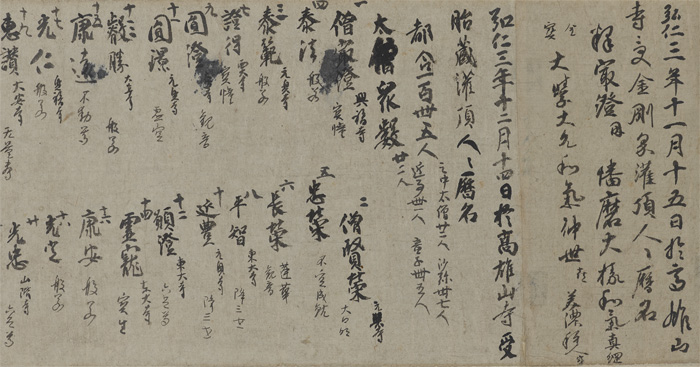
[Jingoji Temple, Kyoto]
Heian period, Kōnin 3–4 (812–813)
This is a register of the names of those who received ordinations (Skt. abhiṣeka) into the Diamond World and Womb World at Takaosanji Temple starting in 813 (Kōnin 3) and into the next year. It is in the hand of Kūkai (774–835) himself. Saichō (766–822), who transmitted Tendai Buddhism to Japan, had requested that these rites be performed; his name appears at the top of the register.
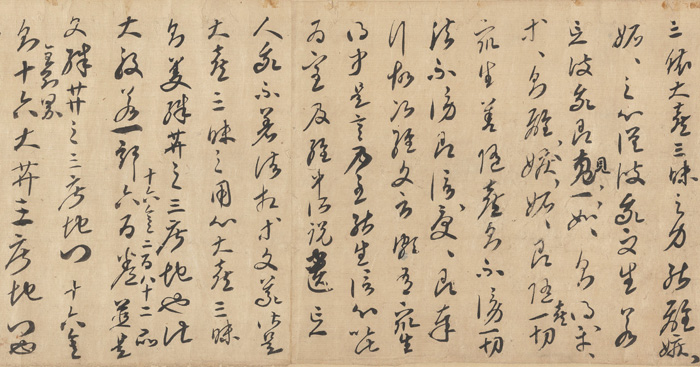
[Nara National Museum]
Heian period, 9th century
This work by Kūkai on the Vajracchedikā Prajñāpāramitā Sūtra, which emphasizes the wisdom of renouncing attachments, explicates the more obscure meanings of the scripture’s teachings from the perspective of mikkyō Buddhism. Glimpses of Kūkai’s efforts to revise the text are seen in his corrections added in the margins of one section between his lines of light cursive brush traces.
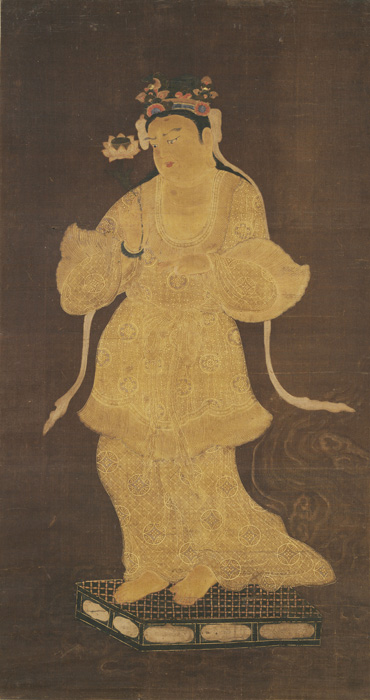
[Ryūkōin Temple, Wakayama]
Heian period, 12th century
By legend, the bodhisattva Kannon (Skt. Avalokiteśvara) manifested on Kūkai’s ship to calm the stormy seas as he made his return from Tang-dynasty China. This painting is understood to be a depiction of that divine emanation, yet the unusual figure is rather a different deity who protects practitioners of mikkyō rites. The painting likely came to be associated with the episode of Kannon’s protection as Kūkai faith swelled.
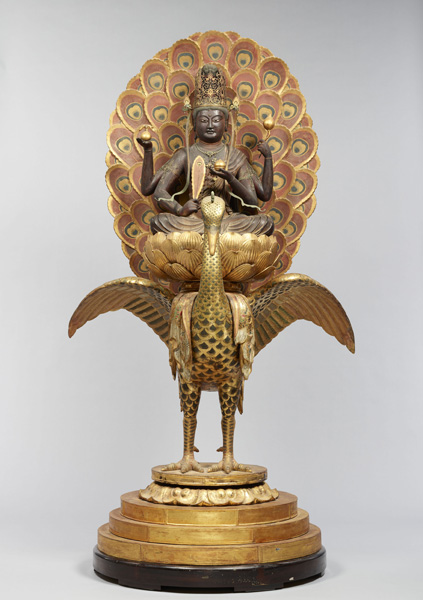
[Kongōbuji Temple, Wakayama]
Kamakura period, ca. Shōji 2 (1200)
Kujaku Myōō is worshipped as a protector from all kinds of disasters, in part because the Wisdom King takes the form of a peacock, and peacocks are known to eat poisonous snakes. This statue is the principal icon (honzon) of the Kujakudō at Mount Kōya established at the behest of Emperor Go-Toba (1180–1239; r. 1183–1198). The style of the master Buddhist sculptor Kaikei (d. before 1227) is reflected in the icon’s august features, the graceful arrangement of its four arms, and the orderly folds of the robe.