This was originally paired with another shrine that is now owned by the Cleveland Museum of Art in the United States. Three hundred scrolls of the total 600 that comprise the Daihannyakyō (Skt. Mahāprajñāpāramitā-sūtra) were kept in each shrine. Sanskrit seed characters representing Shaka (Skt. Śākyamuni) and Amida (Skt. Amitabha) are painted on the interior wall. Eight deities from the Tenbu, the portion of the Buddhist pantheon composed of non-Buddhist deities that were incorporated into the Buddhist pantheon as protectors, are vividly painted on the doors. Together with those on the doors of the paired shrine, they form the Sixteen Protective Deities who guard the Daihannyakyō.
Object label
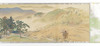
These are two picture scrolls from a set of three based on Natsume Sōseki’s (1867–1916) novel Grass Pillow (Kusamakura). Altogether twenty-seven people collaborated to produce it, with a different artist responsible for each section. Among them were the Nihonga painter Matsuoka Eikyū (1881–1938) and his students Iwata Masami (1893–1988) and Yamaguchi Hōshun (1893–1971). This is an important work representing the New Yamato’e Society (Shinkō Yamatoe Kai) at its height. Many of its members participated in this project.
TANIGUCHI KoseiEnglish by Mary Lewine
Buddhist Art Paradise: Jewels of the Nara National Museum. Nara National Museum, 2021.7, p.330, no.224.