


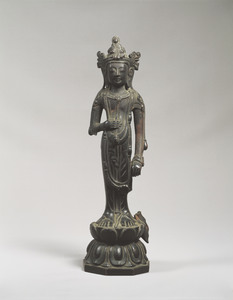


This strikingly elegant and slender statue can be identified as the bodhisattva Kannon (Skt. Avalokiteśvara) on the basis of the prominent transformation Buddha (kebutsu) at the top of its head. It stands with its right hand to the ornament at its torso, an unusual pose. There are three other known statues in the same form. It is presumed that these were made within the same religious and geographic context and then disseminated.
YAMAGUCHI RyusukeEnglish by Mary Lewine
Buddhist Art Paradise: Jewels of the Nara National Museum. Nara National Museum, 2021.7, p.349, no.42.
A transformed Seated Buddha (kebutsu) appears in the center atop its forehead and in the right hand it holds the beaded ornament. In contrast to the head and hands which are rendered on a relatively large scale, the body is slender. These proportions are characteristic of the Asuka period sculpture of the 7th century.
Yasuo Inamoto
Masterworks from the Nara Buddhist Sculpture Hall at the Nara National Museum. Nara National Museum, 2010, p.137, no.159.